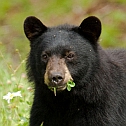
According to the British tabloid the Daily Mirror, a quick-thinking Montana woman fended off a bear attack with a 14-inch courgette. Is this some sort of ax, shovel, or broom? No. Here’s a hint: a courgette is perfect sautéed in garlic and butter.
If you are of British extraction, you may recognize the weapon of necessity as the humble yet prolific zucchini. A green variety of summer squash, and bane to spelling bee participants, the heroic zucchini deserves a moment in the spotlight, at least linguistically.
Zucchinis are the fruit of Cucurbita pepo genus, the botanic family of gourds, summer and winter squash. Squash is a shortening of the Native American Narraganset word askutasquash, borrowed by the early European settlers to Rhode Island. Askutasquash literally means “the green things that can be eaten raw” — a pretty succinct definition.
The unassuming zucchini is a world traveler. While its biological origins are in the Americas, its name and importance to European culinary tradition has to do with its popular debut in Italy during the 19th Century. A diminutive of the Italian word for squash, zucca, was applied to the small green fruit fresh off the boat and became zucchini. So, how did this New World fruit with an Old World name come to be called a courgette? As the popularity of summer squash spread through the kitchens of Europe, the French designated the fruit in the same pattern of the Italians; courge, the French word for squash, became courgette, and from there, the fruit and its French name migrated to England.
The beauty of this vegetable tale is rivaled by the mystery of how “coffee” got its name. Drink of this knowledge, here.

The best capuccino I have ever had was at some cafe in Rome; just right before the busy hour in the morning.
“While *its* biological origins…”
[...] “COURGETTE” could be added to the “BEAR 0 STEW” on the Washington Monument Hill. — Throw in [...]
THIS IS THE MOST EXCITING HOT WORD THAT I HAVE READ
WHAT A BEAUTIFUL HOT WORD THAT I HAVE READ IN THIS WEBSITE
“…its biological origins…”, please. Not “it’s.”
But thanks for the interesting explanation of this word.
How did the Montana woman fend off the bear with a 14-inch(?) zuucchini?
Throw it away from her so the bear would go after food?
Interesting vegetable tale.
And here I thought Rhode Island has brought nothing to the table. All these years, they’re responsible for naming squash…
This whole article is a really cool bit of trivia. Me likes.
This article makes no sense
why does she uses a courgette does she want him to eat her or somtin ![]()
will she might want to get reaed of her life
hi ?!?!?!?! nvm nice breif
Sorry, I was distracted from the lovely vegetable tale by a woefully-misplaced apostrophe. Did you really mean “While it is biological origins are in the Americas . . .”? Because of course this is nonsensical. It’s particularly confusing because you get the possessive form correct in two other places *within the very same sentence*.
Oy, I have to sit down to recover from this one.
i do not know if the story is really realy can someone please type back and answer my question please and thank you
it dont say a lot about the bear and the lady what happen to her and was the bear killed or did he/she get away befor any one could get to the bear ?
This is kind of off topic, but I know British people call a lot of things different. For example, they call flashlights “torches”. That’s cultural diversity in a word kind of sense.
Lol, where do people actually do this stuff at. If i was being attacked by a bear, the last thing i would of thought of is to grab my courgette. But still, wow, im surprised it works, iv always wondered
Wow this is weird information and it awesome that a woman can fight a bear with a piece of zucchini, but yeah it was 14-inches long…. ☺
Article has interesting facts, but no detailed information about the bear event that occurred. After reading the story, I feel as though the title of this article was misleading.
If you are of British extraction, your ancestors from only a few hundred years ago will have invented the language that modern day Americans have added 430 misspellings to, including spelling the word “dialect” as “language”.
“European settlers” is an anachronism.
Hilarious!! But, what DID she use to fight off the bear?
An interesting migration of words… Your skills in punctuation do not equal your skills in etymology; “While it’s biological origins” should be “While its biological origins,” unless “are” and a partial “is” are to coexist in the same phrase.
i would of thought that she got a huge mirror and had the bear see its reflection and then get scard himself by thinking the bear in the mirror was some other threat.. that would be good
Wow.
I really just wanted to know how the woman fought off the bear with a courgette. But you didn’t say anything about that. Bait and switch. I’m very disappointed!
That is not funny! Put yourself in that position, whereas your getting attack by a bear. Wouldn’t you grab anything to defend yourself? That’s what that women did and most of you would pee in your pants in runaway. If anyone should be laughing it certainly shouldn’t be YOU!
Wow the website made a mistake. I might die. Wow. Just wow. Does it really matter people?!?
Never mind the bear, – I can’t believe the grammar in these comments!
Food to the rescue!
Why tell a tale about a woman with a 14inch courgette duelling a weapon-less bear and NOT say who won?? There will be flocks of children out with their “zucchini’s” attacking wild animals! Anyway, why call it a zucchini? What is that derived from?
Heard its the bear the killed Tristan in Legends of the Fall. She’s tougher than Brad Arm Pitt
The bear started coming into her house and she was able to shut the door partially on him but his head and shoulder still stuck through. She happened to have a zucchini on her counter top and clobbered the bear with it.
Reference:
http://billingsgazette.com/news/state-and-regional/montan/article_ef1fedf2-c726-11df-8c9f-001cc4c03286.html
I live an hour away. I saw the news clip. This is pretty awesome that it’s getting international attention. Montana of all places….
What happened to the education system? Are students no longer learning English? It’s (as in it is) bad enough the article is poorly written and poorly composed (starting on one topic and ending on another,) but the commentary below is worse. Atrocious is a better word, I’m not trying to be a snob, but really? Are subject/verb agreements and complete sentences too much to handle?
Weird, Exciting, and did I mention she’s crazy?
you can read the story here: http://www.bbc.co.uk/news/world-us-canada-11401167
I too would like to know how she got rid of the bear. I am glad to know what a courgette is though. Thanks
Finally a reasonable use for a zucchini.
You know, IT IS people like Jim Furlong, Tracy and Sean that will eventually keep people from adding anything to this site. Was it totally necessary, when you finally got up off of the floor and caught your breath because of having the wind knocked out of you over a
misplaced apostrophe, to expose that tiny error to the author of a wonderful tale or anyone else who happened to drop in on this?
Thank you Mr. Author, I enjoyed it very much.
And a large courgette is called a marrow in the UK
Soooooo…. hmmmmm I kind of wanted to know how the lady fought off the bear. Did she see the bear coming for her while she was outside of her house, and then she ran inside picked up the courgette and then smash it down the bears throat, and then the bear choked to death? But thank you for the information on a courgette.
Hmm. It says a British TABLOID. Sounds to me that they were trying to make a crude joke. 14 inch “zucchini”… yeah right
if you know what i mean >.<
What is she doing alone with a 14-inch courgette in the woods anyways….?
Hmm….
OH NO! A misplaced apostrophe, what will happen to the world!… You people get annoying with your constant whining about other people’s grammar mistakes. Sigh, are you serious? Your comment was basically the definition for a snob.
It’s a true story, first published in the Missoulian, the daily newspaper in Missoula, Montana, and on the Missoulian’s website, Missoulian.com.
Here is a link to the full, amazing story: http://missoulian.com/news/local/article_aaae89f6-c741-11df-9ea6-001cc4c002e0.html
While correcting your it’s vs. its mistake you created another: “… tradition has to do with its popular debut in Italy [in] during the 19th …” I presume should read “… tradition has to do with its popular debut in Italy during the 19th …”.
Even Microsoft’s Word catches mistakes like that.
@Graham: Such a high opinion of yourself. If it was not for us you would have German as your native language, all things considered, probably with a Bavarian dialect.
[...] today came a most unusual post on “The Hot Word” at Dictionary.com. And that post, in turn, was inspired by one in the British tabloid the Daily [...]
Wow!!!!!!!!!!!!! so how did she fight the bear!!!!!!!!!!!!!???????????
Summary from all the links:
200 pound bear wrestled her dog She threw something the size of a watermelon at it, and kicked it, then it ran off.
It must not have been a very large bear, some DOGS weigh more than that.
Bears in Alaska don’t give two crapsticks about zucchini. You get eaten regardless of how much produce you throw at it because you’re on the bear’s turf.
Okay I just want to know what she was doing in the woods with a 14-inch zucchini anyway
She was at her home. Read.
I personally dislike garlic, but I love garlic bread.
OMG THIS IS KRAZY!!!! I MEAN DANG WHAT IS THIS WORLD COMING TO?????
@(‘_’)@(<– THIS IS A MONKEY FOR THOSE WHO DIDN'T KNOW!! A LIL OFF TOPIC)
**BUTTER**
zucchinis like gummy bear turnips in the star time
Thank you for sharing excellent information. Your website is very cool. I am impressed by the details that you’ve on this website. It reveals how nicely you perceive this subject. Bookmarked this web page, will come back for more articles.
Garlic and butter makes alomost any food taste better. Adding some olive oil to it reduces calories and heavy stomach.