Is this goodbye to the typewriter? Learn the love story that helped create the typewriter

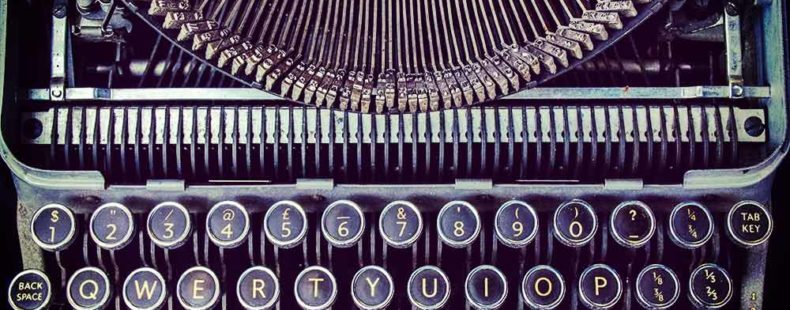
Typewriter enthusiasts around the globe are probably feeling a bit blue this week after hearing that Godrej and Boyce, one of the world’s last operational typewriter factories located in Mumbai, India, closed its doors for the last time after an impressive one-hundred-and-fourteen year run. Once regarded as an indispensable device for any writer, the typewriter has long been regarded for both its beauty and functionality. Ernest Hemingway once said, “Typewriters write the way people talk.” Does this mean the end of a long conversation – a conversation that began almost three hundred years ago?

From Henry James to Jack Kerouac, Hunter Thompson to David Sedaris, the advent of the typewriter has helped shape the English language for centuries. In E.E. Cummings’ “Grasshopper Poem,” the writer intentionally uses the typewriter for poetic effect, and William S. Burroughs wrote of a “soft typewriter’ writing our lives, and our books into existence.”

(Find out the interesting history of the keyboard, the meaning of “QWERTY“ and what “typewriter words” are, here.)

Perhaps the impending obsolescence of the typewriter began in the 1980s with the rise in popularity of the word processor and the personal computer. These inventions quickly overshadowed their precursor, primarily due to their efficiency and ability to store and retrieve documents. It’s that same efficiency that may have driven Henry Mill to obtain a patent in 1714 for a “Machine for Transcribing Letters” onto paper or parchment.

As in the case of Italian inventor Pellegrino Turri and his design in 1808, many early typewriters were developed to enable the blind to write. Inspired by his affection for the Contessa Fantoni, a childhood friend in the early stages of blindness, Turri invented a machine that allowed the Contessa to communicate with the world. The affectionate correspondence between the two would later inspired the love story in Carey Wallace’s The Blind Contessa’s New Machine.

By the late 19th century, hundreds of typing machines were patented throughout Europe and North America, and while many of these patents would fail to see the light of day, John Pratt’s “Pterotype” would become the prototype and inspiration for Christopher Sholes’ invention of the standardized typewriter in 1867.

Interestingly, Godrej and Boyce’s top customers were Indian defense agencies, courts and government offices – citing habit and emotional attachment as their reason for keeping it old school.

This post has been updated as we have learned that Godrej and Boyce are not, in fact, the last manufacturers of the typewriter. Long live the typing machine!

which matters more: body fat or BMI?

Shape October 1, 2004 | Schlosberg, Suzanne Which is the more important gauge for slimming down: body mass index (BMI) or percentage of body fat? We answer three of your body-measurement guestions here.

Q What is the difference between BMI and body-fat percentage?

A Although both are ways of estimating how “fat” a person is, body-fat percentage is a more useful tool because it distinguishes between the weight of fat and that of your lean body mass – bones, organs, muscle and connective tissue. But there are no hard and fast rules on the ideal percentage of fat, says exercise scientist Larry Tucker, Ph.D., director of the Body Composition Laboratory at Brigham Young University in Provo, Utah: Some say the upper limit of healthy for women is 32 percent; others argue for 35 percent.

However, the location of the fat is probably more important than the amount of fat, Tucker says. Most methods of body-fat testing don’t reveal how much fat is located in the abdominal area and how much is located elsewhere. Excess deep abdominal fat, clumped around your organs, is linked to increased risk of diabetes, heart disease and other serious conditions, whereas ample hips and thighs likely pose fewer health risks. see here body fat percentage calculator

As a measure of disease risk, your waist circumference may be more useful than either BMI or body-fat percentage. Women with a waist measurement greater than 35 inches are at higher risk for the diseases above, according to the National Institutes of Health.

If you’re trying to slim down, body-fat percentage can be a helpful way to gauge your progress; however, Tucker emphasizes, “there’s a lot of potential error in body-fat measurement.” Even the most accurate methods, including underwater weighing and a DEXA body scan, have a margin of error of about 1-3 percent when performed by even the most experienced technicians. Less-accurate methods, such as skin-fold calipers and bioelectrical impedance (see guestion on next page), can have a margin of error of 4 percent – even greater if the tester doesn’t do everything precisely right.

Q I just got a fancy scale that gives your body mass index. Being 5-foot-5 and 140 pounds, I was expecting my BMI to be in the low 20s. To my surprise, it turned out to be 29.6, as opposed to the 23.3 I got using Shape.com’s BMI tool. According to one reading I am healthy; the other says I’m overweight. Which should I believe?

A “The 23.3 is correct,” says body-fat expert Larry Tucker. One way to verify the number is to do the math yourself, plugging your height and weight into the formula for BMI: weight in pounds x 704.5; divided by [height in inches x height in inches]. In your case that would be: 140 pounds x 704.5 = 98,630, which, divided by 65 x 65, comes to 23.3.

However, Tucker notes, don’t rely on your BMI results to determine whether you are healthy. It’s important to consider these numbers in conjunction with other health factors such as your levels of activity, blood pressure and cholesterol, and how much body fat you have and where it’s located. Because BMI takes into consideration only height and weight, it can be inaccurate if a person has a lot of muscle mass, which weighs more than fat. “A lean, muscular athlete may register as obese on the BMI chart,” Tucker says. (Someone with a BMI of 25 or greater is considered overweight, and a BMI of 30 or more is considered obese.) BMI also may be inaccurate for people who have little muscle. “As people get older, their muscle mass tends to decline,” Tucker says. So a person’s weight – and BMI – may stay the same even though a greater proportion of the person’s weight is fat.

Q This morning I got a body-fat analysis done at my gym. I stood barefoot on a high-tech scale and received a guick printout, but nobody explained the results. What are TBW, FFM, BMR and impedance?

A PTG01C5aTBW is an acronym for “total body weight” and FFM is short for “fat-free mass,” the weight of everything in your body that is not fat. BMR means “basal metabolic rate” (aka RMR, or resting metabolic rate) – in other words, “how much energy [in calories] your body would expend if you were just lying still all day and hadn’t eaten for at least 12 hours,” says Tony G. Babb, Ph.D., a research scientist at the Institute for Exercise and Environmental Medicine at the University of Texas Southwestern Medical Center in Dallas.

The BMR number that appeared on your body-fat test results was predicted from such measures as your age, gender, total body weight and body composition; however, Babb emphasizes, it’s only a rough estimate. “Measuring oxygen consumption is more accurate, but you’d have to breathe through a special mouthpiece in a lab,” he adds. this web site body fat percentage calculator

Impedance is the term for the method used by the body-fat scale you stood on. Also known as bio-impedance analysis, it sends an alternating current through your body from one foot to the other. The faster the electrical signal travels, the more muscular you are. That’s because water conducts electricity, and muscle contains significant amounts of water; fat contains virtually no water, so it impedes the signal. The scale uses the speed of the signal to calculate your body-fat percentage.

This method of testing is very sensitive: How well-hydrated you are when the test is done, and your temperature, prior exercise and meals, all can affect results. Also, impedance devices are typically less accurate for people who are obese or very lean. For best results, get tested first thing in the morning, before you’ve eaten or exercised but about a half-hour to an hour after you’ve had a glass of water. Also, avoid testing during menstruation because some women retain water during that time. Even then, Babb says, “take the results as a gross estimate.” [Sidebar] A waist measurement over 35 inches puts your health at risk.

[Sidebar] Consider your BMI along with other factors – activity level, blood pressure and where you store body fat.

[Author Affiliation] Suzanne Schlosberg is the author of The Curse of the Singles Table (Warner Books, 2004).

Schlosberg, Suzanne

72 Comments
Kel' on April 29, 2011 at 2:50 am

nice fact, we prefer to use soft keyboads ^^

Class of 2012 on April 29, 2011 at 5:19 am

I still think it is so sweet if people write letters to eachother. Like little love notes and stuff like that!

KaraangGamit on April 29, 2011 at 5:29 am

Sad,really sad… alot of bad, good and great books made by bad, some good and great writers done in typewriters,… and they treated it like a there own child or something. But come to think of it, because of typewriter, computer keyboard was made. I can still remember in my college days where I took up IT course major in Multimedia and Internet where in school, we use computers(of course duh, eshtuped meh…) and when I had my “On-the-Job” training, I was sent to a government office and they assigned me as an “encoder”, and viola! they gave me a type writer, a very old typewriter… I can still remember when I tried to type fast, those metal stick thingy with letters on it would scrambled or it wont hit the paper at all…it was a torture, my fingers hurts and I felt embarrassed that I finish typing a three paragraphs speech in about 2 hours or more. TYPEWRITER, your name will and good deeds will be remember FOREVER.
*end*

Ben on April 29, 2011 at 5:43 am

good riddance ol’pal..:’c

Anonymous on April 29, 2011 at 5:49 am

The typewriter is still alive with Brother!

Kat on April 29, 2011 at 6:27 am

I really like the green typewriter in the photograph…where was this found, and is there a way for me to purchase it?

:D on April 29, 2011 at 6:34 am

Didn’t say anything much about the love story…

Preston on April 29, 2011 at 6:49 am

I didn’t know type writers were still in production, until now. I thought that story about Turri and Fantoni was pretty romantic, although did you mean that his invention fueled by love was the inspiration for the prototype of the standard type writer? Anyway I think this, like all of the “Hot Word Blogs” was very interesting.

Preston on April 29, 2011 at 6:52 am

Just think of it this way the type writer will still exist in history, and many more trees will be saved through the use of online books. I say we only save sacred and important books for having copies printed on paper and leave all other digital.

Class of 2012 on April 29, 2011 at 7:06 am

Yeah so what about the love story? Just want to know. So if anyone is reading this please feel free to answer.

"..." on April 29, 2011 at 7:14 am

Bless all useful objects,the spoons made of bone,the mattress I cook my dreams upon,the typewriter that is my churchwith an altar of keys always waiting. -Anne Sexton

The Dude on April 29, 2011 at 7:18 am

Did you know that typewriter is the longest word you can spell on a the top row of a qwerty keyboard?

Michael on April 29, 2011 at 8:19 am

oops, sorry for the double post.

Liza with a Z on April 29, 2011 at 8:25 am

There’s something about a typewriter that forces the author to think of his or her words before they appear on the paper. The thought is probably completed before it hits the paper. With a word document, you can edit and re-edit without having to retype. It gives you time to pause, as if to say, “Do I really want to write that?” I can’t imagine someone like Kerouac “editing” himself in that way.

BTW…it should be e. e. cummings (lower case)

ludwick on April 29, 2011 at 8:29 am

it gave way to new inventions in technology.

JOSEPH DEVARAJ on April 29, 2011 at 8:38 am

they didnt tell about the love story of typewriter. i want the story .u send to my mail.

José on April 29, 2011 at 9:07 am

I still own two typewriters, one mechanical and the other electrical and I vividly remember when my mom bought the latter we were all amazed at the fact that it could “erase” words. Now all that seems kind of funny in a time when we have a desktop and laptops in my house but I still give a look to those old typewriters and I can’t help feeling a bit sentimental because even though sometimes some keys wouldn’t work or you had to replace the tape at the last minute or you made a mistake and had to pull out a complete half-written page all outraged they were a big help in my first jobs. Good bye old friends, you will always have a place in my memories and in my closet where you shall rest for many years to come.

Y' haun-a on April 29, 2011 at 9:15 am

So what is with it saying about a love story when it talks about it none?

Dylan on April 29, 2011 at 10:17 am

Kate and Will together beats yours.

Eyewitness on April 29, 2011 at 10:29 am

I wish Gutenberg could see this–from movable type to bits and bytes.

Arline on April 29, 2011 at 10:37 am

Could it be that the “love story” was just a lure to read the article? Oh, surely not!

Joy Corcoran on April 29, 2011 at 11:03 am

If we ever have energy shortages, the good old manual type writer would still be a useful machine. I wonder if typed letters could become an art form, like calligraphy. Remember how computers were supposed to make paperless offices, every office I worked in everyone printed up endless copies of endless emails. I wonder what writing tools will be like in another 30 years?

Mr. D [A.K.A] Elysian on April 29, 2011 at 11:03 am

lolwut?

rudwally on April 29, 2011 at 12:06 pm

Luddites who wax sentimental over the demise of that instrument of torture almost subdue my patience. (Gawd, when I think of the time wasted retyping pages…. )

Lee Rivas on April 29, 2011 at 12:50 pm

I’ll hold on to my 50 year old manual student typewriter….just in case. Never know when our electrical dependence will be shut off.

Karen on April 29, 2011 at 1:01 pm

I love typewriters. Nevermind the fact that I have never seen one in real life and therefore have never used one, they are still amazing. The sound they make and just the old-fashioned-ness of it all just makes it so endearing to me.
I do plan on owning one in the future so I’d probably better get cracking on that if one of the last few manufactors of this typing machine has already closed its doors.

JJ Rousseau on April 29, 2011 at 1:12 pm

Garbage in – Garbage out, Oui? Woof.

Anonymous on April 29, 2011 at 1:27 pm

Um, in the second-to-last sentence of the post, the word “manufacturers” shouldn’t have an apostrophe. And on a blog about language, too…;) I see that everywhere.

Gary on April 29, 2011 at 3:38 pm

I was so obsessed with typewriters in the 1980s it’s all i could talk about. I got a plastic one before high school and then went to a IBM selectric but I couldn’t master the skill. I went crazy with excitement when our school in the late 1980s got IBM Selectric Wheelwriter 3 typewriters. The clicking in class was an amusing sound.

I still have 2 electronic typewriters.

The funny thing is that I was called a lot of unpleasantries over the years admitting to other males that I can type. I got a job where typing was one of my main duties. The really funny thing is in the internet age, a lot of males are not shocked by how fast I can type.

Goes to show how things change. But, I still love typewriters

Dr Juan on April 29, 2011 at 4:35 pm

Does this mean that I will finally have trouble finding ribbon for my dot matrix printer? I haven’t changed ribbons in about 3 years. Compare that with inkjets which seem to be expensive to operate!

Ray Shell on April 29, 2011 at 7:13 pm

This sounds interesting. Typewriters are cool. :) Yet again…present-day…

i-nonym on April 30, 2011 at 12:51 am

Things change. A fact in daily life that everyone still gets butthurt over. We got to accept changes, otherwise we will never improve, and remain to be cave men.

Dimitri on April 30, 2011 at 12:58 am

I own a typewriter myself. I have acquired it only a few months ago. I just could not resist the worm feelings of nostalgia that it evokes in me. It is a symbol of a simpler time. When I look at a typewriter I can easily and fully comprehend its inner workings. However, when I look at a computer, all I can see is a magical box. It has virtually limitless abilities and capabilities harnessed to perform frivolous tasks such as playing video games, downloading and playing movies and many others. I doubt that many people understand the inner workings of the simplest microchip, but many claim to be “good with computers”. It takes years for a whole team of specialists to design a new Windows program just so that some fourteen year old girl could log onto Face-book. For all of its limitations and inconveniences, the typewriter, at least made sense. P.S. I am not some old coot, I am 26.

Kuya Jobert on April 30, 2011 at 1:36 am

Well typewriters are so helpful in the past but now a days its just a toy :) but we cant deny the fact that the origin of the keyboards are the typewriters. but in our country they still use typewriters specially in our police department LMAO :D :D :D

Magical Mystical Teacher on April 30, 2011 at 2:02 am

“Christopher Sholes invention”

The inventor’s name should have an apostrophe, because it is his invention. Thus:

Christopher Sholes’ invention

I hope you make this correction to your story.

Noone on April 30, 2011 at 3:44 am

For my next birthday, i wnat a type writer that works so i dont have to use my computer all the time for my writing.

Melody on April 30, 2011 at 4:24 am

It’s interesting how a love story – so distantly related to a typewriter – actually “invented” it! That is such an unbelievable story (but I still believed it, of course!). Too bad the QWERTY keyboard has taken over… typewriters deserved the fame with such a crazy history! Fortunately enough the typewriter hasn’t fully disappeared, with some brands still sporting them! At least we can preserve the wonderful typewriter for as long as those brands produce them!

Way to go, Hot Word! This was a fantastic article that I loved and inspired my spirit! Speaking of love, maybe it can ignite another invention idea sparking in someone’s mind… :)

clark on April 30, 2011 at 5:13 am

The love story behind yhis are on the posts you have posted your every little stories about your encounter with the so called typewriter. get it. . . . . . . . . . . .duh./

KobiMadd on April 30, 2011 at 6:12 am

I recently got a typewriter as an early birthday present, but now after reading this article I have come to realise how difficult it is starting to be to continue operating it.

Mike on April 30, 2011 at 6:50 am

I don’t understand the mourning and sentimentality. The typewriter is more prevalent now than it ever was; it just has a different form brought about by advances in technology. I’m sure my old Smith-Corona resembles my computer keyboard more than it resembles the original typewriter. If keyboards are completely replaced by reliable voice recognition, that will be a different story.

By the way, 1808 was two hundred years ago, not three.

A.S.H. on April 30, 2011 at 8:03 am

Although today’s society is pretty much all about technology, I don’t think typewriters are completely replaceable. What happens if there is no electricity? Then it’s all back to hand written letters again…

Ellie on April 30, 2011 at 8:28 am

Love typewriters!! I have an electric Smith & Corona(practically brand new) which I love using. It brings back memories of my days as a secretary, doing shorthand and typing away constantly. Really, the computer keyboard is a typewriter???!!!

Luke Javan on April 30, 2011 at 8:55 am

NBC news reported the closing of the last typewriter maker, whether
the one mentione above or not I don’t know, but it was untrue. There
is still one company left making them.

awestruck on April 30, 2011 at 9:07 am

i can remember clacking away on a manual in the late 50s in high school. It was a fairly
physical job when the typewriter was old, over-used by students and not maintained properly.
(Sticking keys had to be pounded with ring or pinky fingers to make them hit the paper against
the carriage. I can remember the thrill of finally becoming a good typist and being able to
quickly get to the end of the line and slam the carriage back to the left and make the bell
ring. Wham-Bing! Wham-Bing! I miss the sounds of a typewriter! (For those of you who
don’t know those sounds, Google “the typewriter song” for a real ear-full.

When electric typewriters took over I was hesitant to try them, but soon got over it because
the speed was incredible. Then when IBM came out with those removable script balls, I
became a convert. Loved being able to change the script to fit the situation or my mood.

What I do not miss, whether using a manual or electric, was having to use carbon paper to
make copies….as many as 4 or 5! If you made a mistake you had to correct, with a pencil eraser, every error. Later on chalk paper strips were used over the typo….even later came
White Out. When you thought your work was perfect you gave it to the boss man who
would scribble on the Original (!) because he changed his mind about something. That
drove me crazy and led me to say that no man should be an executive without FIRST
interning as a secretary for a couple of years. Back then, 99% of bosses were men and
very few ever learned to type, never mind know what secretaries suffered because of their
lack of knowledge.

I still have a small portable Remington in storage. Can’t give it up. However, when I
first saw what incredible ease computers made possible, I applauded progress.

Melanie Alcalde on April 30, 2011 at 10:15 am

I own a desktop computer. I still got my electric Brother typewriter which is useful to insert one envelope to type the name and address of the recipient instead using handwriting, a touch of professionalism.

I still remember how I enjoyed the sound of the typewriters in typing class. How I admired students hitting the keyboard with rhythm (like a sound of music) and blind folded whilst teacher tapping with her long ruler.

I used to love hitting the keyboard as a little girl. Hitting the computer keyboard has no same effect to a curious child how things work.

I regretted not owning an old portable manual typewriter in case there is a blackout so I can still send a letter who can read my missive with ease instead deciphering my awful handwriting.

noah caveny on April 30, 2011 at 2:24 pm

I would like to hear the love story too. Tom Robbins describes his love/hate relationship with his Remington typewriter throughout his novel “Still Life With Woodpecker”.

anonymous on April 30, 2011 at 3:49 pm

My mother gave me a typewriter on my 17th birthday. I made it my life’s work and typed until I was 78 yrs old. Wonderful invention.

Cyberquill on April 30, 2011 at 6:25 pm

The good news is that many pencil and pen factories are still open.

S. Ahmed on April 30, 2011 at 10:22 pm

Yayyy. I still have an old school typewriter, not one of the electronic ones, my grandfather gave it to me. I was gonna throw it away but hmm… I might as well keep it now.

john rhea on May 1, 2011 at 6:27 am

I’m always amused by the comments. I cannot believe the stupidity of some of the people who comment here. @Dr Juan, you are concerned that with the demise of the typewriter, you will not be able to get a ribbon for your dot matrix printer? You haven’t changed it in 3 years and it’s still good? Why not run out and buy a 5 pack of ribbons for $5, so you’ll be good for the next 15 years. While you are out making this purchase, pick up some blank 8 track tapes (for recording), I hear they are going to be discontinued as well.

Pam on May 1, 2011 at 6:35 am

Not so fast – a friend wrote this to me: “I love how this story of the ‘last’ typewriter managed to get in newspapers all over the world with apparently no one bothering to check the utterly obvious facts. Brother still manufactures and sells typewriters. So does Canon. Even Staples carries them.”

Trisha on May 1, 2011 at 6:57 am

When a little kid asked what a typewriter was the answer came out to be like a computer only you don’t have to print out what you wrote because it prints it as you write. How about those typewriters that had balls you could interchange to get a different font? And the guy who decided how the keys would be put in a certain position did it on purpose so you couldn’t type as fast as you could if they were in another position. He didn’t want our finger to go too fast & get overly tired. But imagine. We all learn to type on keyboards that are all the same but could be better.

Maggie on May 1, 2011 at 9:07 am

My mother wouldn’t let me drive until I was both 18 and could type 45 wpm! I was artistic-minded, and she was afraid that I wouldn’t be able to support myself unless I could type. She passed on in 1985. I know that she would smile at how far technology has come in my lifetime…and also that I am generating income without a typewriter. I miss her.

Aila on May 1, 2011 at 10:07 am

Love typewriters,though I haven’t seen one.

WALNUT on May 1, 2011 at 11:48 pm

HOW GLAD I WAS TO LAND A JOB WITH THE L.A. COUNTY RECORDER, MAME B. BEATY IN 1942. WE USED THE OLD MANUAL TYPEWRITERS AND I TYPED 87 WORDS PER MINUTE. SEARS HAD FIRED ME FOR BEING MARRIED. THAT WAS THEIR POLICY BUT THEY COULDN’T GET AWAY WITH IT NOW.
LATER I BOUGHT MY OWN TURQUOISE PORTABLE ROYAL ON WHICH MY TWO BOYS LEARNED TO TYPE. IT RESIDES INSIDE THE CLOSET NEAR MY COMPUTER WHICH I RESPECT BUT DON’T LOVE LIKE MY DEAR, OLD, TURQUOISE, ROYAL PORTABLE.

Lando on May 2, 2011 at 6:12 am

Actually it should be “Christopher Sholes’s invention.” Form the possessive singular of nouns with /’s/.

Book Beater on May 2, 2011 at 7:19 am

We all love the written word.
The real love story is in what we write to each other right here, to people we’ll never know; on our cell phones, and in our e-mails to the people who fill our lives.
We owe it all not to some industrial Italian, but to Trog who drew that first picture of the hunt on his cave wall.

Bella on May 2, 2011 at 8:02 am

The quick brown fox jumps over the lazy dog.

Spike on May 2, 2011 at 8:17 am

Like many others here, the typewriter is a piece of nostalgia for me. Kolchak the Night Stalker regularly packed up his old typewriter, hastily pursuing a mummy or werewolf. Warren Zevon sang how “I pawned my Smith-Corona and I went to meet my man”. To this day I remember mistyping the word “scuebtust” for “scientist” in a paper on Michelangelo in elementary school. I still own a Royal which must be getting close to 100 years old. I haven’t used a typewriter in decades, but I will certainly miss them.

Paul B on May 2, 2011 at 8:33 am

I’m 51 and learned to type in a fourth grade summer school class, my parents had to rent a typewriter for me and it was a big deal because we did not have much money. The trick was carrying it back and forth to school everyday seemed like the thing weighed almost as much as I did.

Still remember it. Big, hummed and came to life when you turned it on the keys almost seemed to work themselves they were so easy to type on. To this day I blame my shoulder problems on carrying that machine, but typing has been one of my most used skills.

The IBM Selectric is the typewriter with the ball, and I still believe the best typewriter ever made.

louis paiz on May 2, 2011 at 10:41 am

well goodby typewritter it may become absolite i miss it but it will be more need ti now such as an inkwel or a favorite pen or pencil. you may lough but here in my desk in my left hand side i have my feather, and at home in my bookcase in an special place i have faisan feather that i call my treasure. who knows now i my nedd an specialplace for an old typewritter. thanks

Bill on May 2, 2011 at 12:20 pm

I thought this site was about words?
What is the meaning/origin of the words “type writer”

Megan on May 2, 2011 at 4:19 pm

Do some of the very seasoned senior news people still use typewriters? I remember when I first started in news business, there were several seasoned gentlemen who still used them, & could actually pound out a news story w/2 fingers on a manual typewriter faster than we neopytes on computer keyboard. We all were fascinated.

enema-addict on May 3, 2011 at 11:27 am

i wont miss em

gerbilmama on May 3, 2011 at 12:19 pm

My mother made me take typing in the 9th grade! At start of the class, we were all on manuals, then the girls got electrics while the boys got stuck with the manuals. I remember the terror of Coach Leblanc, our teacher, walking, ready with a ruler to smack our wrists, if we did not type in proper position. I never got smacked, and now 35 yrs later, I have never had any problems with my wrists. Thanks go to Mom and to Coach!!

Pais on May 4, 2011 at 9:38 am

The QWERTY keyboard was, indeed, invented to slow typists down–because some were becoming so proficient that they were constantly causing the mechanical type arms to jam–a problem that persisted until the invention of the IBM Selectric. I had an IBM model “B” that was put into service about the same time I was born (1951) and when I really got smoking I could jam it up royally–and at least once had to have some of the arms realigned. QWERTY works just fine, thanks. Don’t you think that if there were a better design, people would clamor for it? My iPhone has a QWERTY keyboard! And, BTW, I type really fast! If you changed my keyboard, I’d have to learn it all over again.

lol on May 9, 2011 at 9:27 pm

bye typewriter :(

susanmichelle on May 11, 2011 at 10:28 am

Long conversations ended when texting was created..people don’t talk anymore.

S. Alexander Hoebermann on May 14, 2011 at 8:00 am

Most ironic in the article is the capitalization of e.e. cummings. As anyone knows, “e.e. cummings” is NEVER capitalized, a style created because of the defect in his typewriter…

typewriter poetry on January 23, 2012 at 8:25 pm

The typewriter lives!

The Cheshire Cat on April 4, 2012 at 9:16 am

the reason why QWERTYUIOP is the first row of letter keys on every keyboard is because of the typewriter! Apparently the dude that invented it was trying to type something and it came out as QWERTYUIOP.

pand on March 28, 2013 at 12:27 am

The green typewriter in the photo is so beautiful, i like it. What’s a pity that more and more beautiful thing would be far away from us.

Leave a comment
Name
Email
Website

Copyright ©  2013 Dictionary.com, LLC. All rights reserved.
About PRIVACY POLICY Terms API Careers Advertise with Us Contact Us Suggest a Word Help