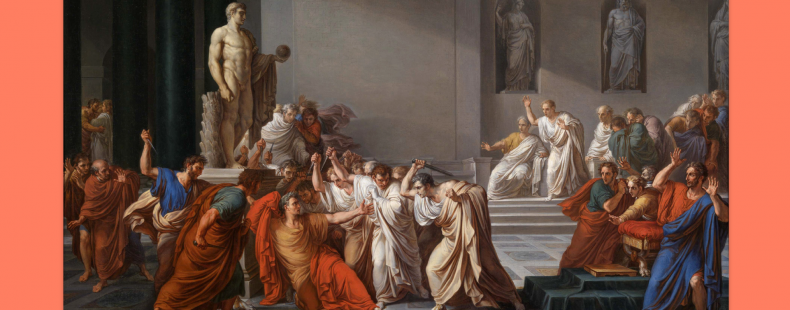
What are the “ides” in the “Ides of March” and what caused the need to “beware” them?

March 15th marks a very inauspicious anniversary. Like a black cat crossing your path, the Ides of March has become a metaphor for impending doom. How did a day that was once celebrated by the Romans become so heavily cloaked in superstition?

The Ides of March is a phrase derived from the Latin idus, a term marking the 15th day of March, July and October as well as the 13th day of other months in the Roman calendar year, and the Latin martii, “March,” which is derived from the Latin Mars, the Roman god of war. The “ide”marks the halfway point of the month—most likely alluding to the day of the full moon. Apparently, devised by Romulus, the mythical founder of Rome, the early Roman calendar cited other dates of the month by counting backwards from the kalends (1st day of the month), kones (the 7th day of March, May, July and October; the 13th day in other months) and of course, the ides.

Once a celebratory day dedicated to the Roman god, Mars (complete with a military parade) the backstabbing of Julius Caesar in 44 B.C. cast a dark cloud. Shakespeare’s “The Tragedy of Julius Caesar” immortalized this dark moment.

Written by William Shakespeare around 1599, “Julius Caesar“ portrays the assassination of the Roman dictator by a group of conspirators. After ignoring the warnings of a soothsayer, a person who professes to foretell events, who uttered the phrase “Beware the Ides of March,” Caesar is stabbed 23 times in the back.

Thus, the same man who brought us the month of July involuntarily inaugurated the phrase “backstabbing.”

American Express aims blue card at ‘Net shoppers.

Network World September 13, 1999 | Haney, Clare It’s been green, gold and platinum. Now American Express is releasing a blue version of its well-known credit card specially designed for shopping online. go to site american express online

Called Blue, the new card today officially launched and contains a smart chip which will offer customers additional security in their Internet-based transactions when used in combination with a smartcard reader, American Express says. Blue can also be used as a traditional credit card since it has the traditional magnetic stripe that can be swiped through and read at point-of-sales terminals worldwide.

In November, customers will be able to register on American Express’ Web site for a software data management and storage application known as an online wallet to better facilitate ‘Net purchases, the credit card company says. Customers only have to enter the required purchase data into their wallet once, such as their name, account number and shipping address. When they want to buy something online, they just click open the wallet and hit the “complete purchase” button.

In order to prevent unauthorized access to an American Express online wallet, customers will be offered free smartcard readers that they connect to their PCs. The smart chip in the Blue card stores a digital certificate unique to each cardholder. When the card is placed in the reader, the cardholder enters their personal identification number, the reader reads the digital certificate and the online wallet can be unlocked. American Express says it will provide cardholders with free smartcard readers through Jan. 31, 2000. After that time, the readers will cost $25 each. this web site american express online

Blue card members are also offered a fraud protection guarantee which protects them against any unauthorized charges made online with their cards, American Express says.

American Express and rival Visa, along with the likes of Microsoft, IBM and Sun, support a universal standard for online wallets called the Electronic Commerce Modeling Language.

~End:

Haney, Clare

30 Comments
mike on March 15, 2011 at 1:06 pm

i like this website!!!!!!!!!!!!!!1

rusty nail on March 15, 2011 at 2:30 pm

fascinating!

Marissa Kelly on March 15, 2011 at 2:41 pm

Wow! Very Interesting! Can’t wait to quiz my friends on this info! ;)

[...] what is an “Ide”? According to dictionary.com, an ide represents the halfway point of the month, most likely in reference to the full moon. The [...]

Silverchild on March 15, 2011 at 3:17 pm

Ides, Schmides

Every year on the ides of March,
My muse reminds me in tones somewhat arch
That I should be penning a noble creation
To mark the date and historic occasion.
She thinks I should write an epic Roman ballad.
I usually just order a Caesar salad.

Poem by William C. Ross, 3/ides/11

Emily on March 16, 2011 at 11:29 am

Knew about the Ides, but very interesting to know where backstabbing came from!

The new thing I learned today!

Carrie on March 16, 2011 at 2:43 pm

Interested to see that the article mentions the word “ide” as if “ides” were a plural word. “Ide” is a suffix and an acronym, but unless something’s changed quite recently, it’s not a word in and of itself.

helena on March 16, 2011 at 3:45 pm

i thought the ides was on the fifth of march… hmmm… looks like i’ll have to change a few ideas i had… pretty cool though… what does the thirteenth have to do with the fifteenth? even in latin, thirteen is nowhere close sounding to fifteen… i’m confused…

JfromI on March 16, 2011 at 3:57 pm

Nice, Silverchild.

This is one of my most favorite posts to date! Very interesting.

chay on March 16, 2011 at 7:22 pm

interesting that i got denied to northeastern on march 15!

AN ELEMENT OF CHIRPY | BLOGCHI@mayopia.com on March 17, 2011 at 9:12 am

[...] [...]

word junkie on March 19, 2011 at 9:57 am

I love this article. What other dates bring with them impending doom?

Japneet on March 23, 2011 at 11:06 am

So it means Shakespeare wrote about things that had actually happened in the history. But aren’t plays like Hamlet and Romeo-Juliet works of fiction? Confused…

So...? on March 24, 2011 at 9:34 am

So people can’t write fiction and nonfiction works of literature? They are forced to stick to one?

idle_kriz on March 30, 2011 at 7:52 am

i still don’t understand this.. so slow..

Olliechick@gmail.com on September 11, 2011 at 1:34 am

my birthday!!!

DukeMutt on October 17, 2011 at 10:25 am

@Carrie, I believe it’s only referred to as “Ides” in a plural form: A. Because that is how the soothsayer told Julius Caesar, B. Because Caesar was stabbed by multiple people, multiple times, and/or C. Because the word “Ide” refers to the middle of the month, and applies to every month, thus making it multiple.

Jeanna on December 19, 2011 at 11:52 am

@Japneet- Julius Caesar was a real person, but Shakespeare wrote a fiction work about him. It was HISTORICAL FICTION, not nonfiction. Most facts in his play are true, but he squished most of the events together, because otherwise the years in between the events would have made the play too long. XP

Anyway, this is interesting… I remember how, last year when I was taking Latin as my foreign language in high school, we had to take the “National Latin Exam” on the Ides of March… which was lucky for me, I had plenty of time to study! ^-^

Andola on February 2, 2012 at 3:27 am

DukeMutt, “C” because the ides occur in three months (but not every month). The same way we would refer to how many holidays there are in a year. Cheers. I like the multiple choice.

Udang on February 2, 2012 at 5:55 am

it is so facinating and cool

Audra on February 2, 2012 at 11:12 am

The first sentence of the second paragraph should have a semicolon after “roman calendar year”, to separate the explanations of 1) idus, and 2)martii. Using only a comma made the sentence difficult to read.

Stacy on February 4, 2012 at 11:54 am

I thought that it was kalends, nones, and ides. I’ve never heard of “kones” before and I took Latin I, II, and III.

Maggie on June 4, 2012 at 7:31 pm

“The Ides of March” is my moms birthday.Lol

Chris on August 12, 2012 at 2:56 am

The Ides of March is my birthday! The day I was born, my uncle said, “beware the Ides of March…”

PT BAL-CO on February 6, 2013 at 6:39 pm

I love the array of comments, corrections, interpritations and just the over all interest in the story that explains somewhat of the unknown.

cool!

Deshanee Barnes on February 7, 2013 at 12:41 pm

This Website is a OK !

Mattski on March 15, 2013 at 4:42 am

Stacy: You’re thinking “nones” as one of the hours of prayers in a medeival monastery: Prime, Terce, Nones, Matins – probably in a modern monastery as well now that I think of it. :)

Love this site; I check it every day. Thank you!

Jim on March 15, 2013 at 3:28 pm

Stacy is right – it is nones, not kones, but the nones occurred nine days before the ides – so it was never on the 13th of any month – it was on the 7th in months when the ides fells on the 15th, and on the 5th when the ides fell on the 13th. The nones was traditionally the day when the holidays for the month were announced.

[...] Dictionary.com Share this:TwitterFacebookLike this:Like [...]

Dave C on March 16, 2013 at 1:27 am

Cool biscuits!

Leave a comment
Name
Email
Website

Copyright ©  2013 Dictionary.com, LLC. All rights reserved.
About PRIVACY POLICY Terms API Careers Advertise with Us Contact Us Suggest a Word Help