A motley combination of Anglo-Saxon, Latin, and Germanic dialects, the English language (more or less as we know it) coalesced between the 9th and 13th centuries. Since then, it has continued to import and borrow words and expressions from around the world, and the meanings have mutated. (Awesome and awful once meant nearly the same thing.) Some specimens in the English vocabulary have followed unusually circuitous routes to their place in the contemporary lexicon, and this series, Lexical Investigations, unpacks those words hiding in our midst.—
Balaclavas and cardigans have more in common than keeping you warm—they both owe their names to the Crimean War. During the Battle of Balaclava in 1854, British troops were underprepared for the cold Ukrainian winter, and unlike their French counterparts, who were allowed to wear as many layers as required to stay warm, the British were expected to adhere to their uniforms. The poor conditions caused a scandal in Britain and motivated civilians to donate money and knit warm clothing for the troops using government-issued patterns and regulation yarn, including a wool cap to be worn under their helmets. The British referred to these caps as Balaclava helmets, and later just called them balaclavas. Troops were also issued button-down woolen jackets, which were named after the Lord of Cardigan, who led their ill-fated charge known as the Light Brigade against the Russians.
Popular References:
Balaclava, Movie (1928)
“Balaclava,” The Arctic Monkeys, CD (2007)
Relevant Quotations:
“Report says, these ill-clothed warriors did not cover themselves with glory in the Crimean war, and that on one occasion, during the attack on Balaclava, having more discretion than valour, they did not wait for the Russians, but retired hastily to the town again, where the women and camp followers, with a sad want of appreciation, gave them such a smart trouncing that the unfortunate Tunisians almost regretted not having kept the field.”
—Hunt’s Yachting Magazine, Vol 19 (1870)
“Mlle Riego gave a crochet receipt for it in her 1854 booklet, but did not call it ‘balaclava’ and gave no directions for knitting it.”
—Richard Rutt, A History of Hand Knitting (1987)
“In the first winter of the Crimean War, British women read reports that their men were dying by the hundreds of exposure to the cold. They began knitting close-fitting covers that left only the eyes expose, then sent the packages to ‘Balaclava.’”
—Andrew Evans and Marc Di Duca, Ukraine (2010)
Sources:
The Crimean War: A History, By Orlando Figes. Macmillan, April 12, 2011, pg 304.
Look and Learn. Issue Number 915. Published on August 4, 1979.
[...] ‘Balaclava’ or a ski mask — Mocha Java in a coffee flask — Why does this seem pointless at this time — Funny though — Almost Greek a Pastry Rhyme — Filo dough — Congressional Sludge green slime. — Seven Eleven Marketing Democracy Withdrawals. — Spinning Wheels Sub Prime. –>>L.T.Rhyme This entry was posted in DICTCOMHOTWORD, L.T.Rhyme and tagged LT, LTRhyme, the HOT WORD on February 26, 2013 by LTRhyme. [...]
How do You pronounce balaclava ? is it balac-lava or bal-aclava or bala-clava?
Another item of apparel who’s name I’ve often wondered the origin of – ” Codpiece”
wat
ARCTIC MONKEYS
In 1965 I was a part of “Operation Deep Freeze” and was privilaged to spend a year in Antartica. At some point during the dark and cold, a New Zealander was kind enough to give me a “Balaclava” to help to stay warm. I cherished that more than anything I had during that time. It kept me warmer than any of the U.S. issue clothing and if faced extreme cold, it’s the first piece of suvival gear I would I would seek out.
I KNOW HOW TO KNIT SO WHO WILL TELL ME HOW TO MAKE ONE? LIVING IN LAS VEGAS IS SUPPOSED TO BE HOT BUT IT’S NOT. SO I WEAR A HAT TO BED—— NOT A PRETTY SIGHT, WOOL SOX AND TUCK MY FEET INTO MY NIGHTY, HAVE A HEATING PAD IN MY LAP. I WANNA MAKE A BALA=CLAVA…. MOTHER-MAY-I ?
lol YES arctic monkeys, first thing that came to mind when I saw this headline
it’s pronounced ba-la-cla-va btw
oh okay. I think I know where this is going.
How do You pronounce balaclava ? same question :p
@ anonymous — bal-uh-klah-vuh
To Anoynymous, the last pronunciation is the correct one here in Britain. “bala-clave”.
To Anoynymous, sorry for the typo error – it should read “bala-clava”.
Anon – It’s pronounced bala-clava.
Interesting… there is a town in Jamaica named Balaclava. Leaves me to wonder how it got its name.
So how about TOQUE? We all pronounce it TOOG but the spelling would suggest TOKE. French no doubt. TOOQ might be a preferrable pronunciation.
And why is this necessary for the survival of humanoids?
Very interesting. I never knew there was a Battle of Balaclava
I grew up very close to Balaklava in Crimea. What a beautiful place!
“A motley combination of Anglo-Saxon, Latin, and Germanic dialects…”
Redundant much?
“In December drinking horchata, I look psychotic in a balaclava.” (“Horchata” by Vampire Weekend)
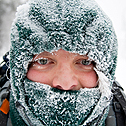
Where’d you get that great photo?
As an Army officer who was formerly enlisted, I was schooled in the difference between a balaclava and a ski mask by more than one person yelling in my face. They are similar, and the words are used interchangeably, but don’t led a Drill Sergeant or a TAC Officer hear you call a balaclava a ski mask. Technically, a proper balaclava has one hole for your whole face, while a ski mask has two eye holes and a mouth hole.
I’ve always heard it pronounced bala-clava.
As for codpiece, someone explained to me that in the days when they were worn, “codfish” or “cod” was a euphemism for the male member. Thus the codpiece was a piece that covered your cod.
@anonymous: It’s pronounced “balaclava.”
none
this is the first time I opened this website.
before I opened this website. I don’t KNOW much ABout an ENGLISH language.
thanks for information.
Hello. Your short “history” above of the English language is quite
wrong : the mixture does not the pudding make.
Stay merry.
IK.
[...] Lexical Investigations: Balaclava | The Hot Word | Hot & Trending Words Daily Blog at Dictionary…. Rate this:Help incite debate and publicize! Share this:FacebookMoreTumblrTwitterEmailPrintGoogle [...]
You mentioned several languages, and germanic language group deserve to be mentioned. I would however point specifically to old Norse and the Norman language, which ended up being a mix of middle French and the bit shall we say degraded old Norse. The Normans didn’t mix all that much unless they were higher up the social ladder, in which case they spoke French of the day.
Anyway I guess I’m off-topic here, but I though that the Scandinavian vocabulary in particular is something one interested in English should do well to remember. As a reminder, place names in northern parts of England, let alone Scotland, give us clear indication. Take Knutsford, named after the Norwegian king, whose name was Knut (a.k.a. Canute), and who was popular.
A friend with a Ph.D in English and vocabulary in particular, says that modern English is/was lexically 66% or abt two-thirds Scandinavian. Hastings was a major factor in the lexical development, as it solidified the Norman population’s standing.
Thank you for these discussions; my little grey cells often get a little workout.
Today Balaklava (sp!) is a charming marina resort town in Ukraine, on the Crimean peninsular. It is lined with chic pavement cafes, small hotels, and very expensive yachts.
Yet the most surprising thing in Balaklava is a former cold-war era nuclear submarine base, tunneled into the sea cliff face, for miles! Miles and miles of artificial channels run through this base. Today the public can go there on guided tours
)
(ˌbæləˈklɑːvə) Mostly like “ball.a.kla.vuh”
lol at first i thought it said “baklava” and i went….ooh yay an article about food! aren’t i stupid….
No Name is my name.
its pronounced bal-uh-klah-vuh
it is pronounced bal-uh-klah-vuh
gnm
nice but how do you pronounce balaclava and when i looked it up on the internet there isn’t even a word called balaclava
In Britain is was always pronounced bala-clava with the primary accent on the first syllable and the secondary accent on the third syllable. Although I am American I don’t ever remember hearing anyone here use the word. In the US they are called ski masks.
@ Bubba, “codpiece”, according to online etymology dictionary:
mid-15c., “a bagged appendage to the front of the breeches; often conspicuous” [OED], from Old English codd “a bag, pouch, husk,” in Middle English, “testicles” (common Germanic, cf. Old Norse koddi “pillow,” Dutch kodde “bag”) + piece (n.).
omg that balaclave thing is soo cool i never tought that i could learn so much in one day about some thing smal
Well i have always pronounced it bala-clava who knows, and no this is not a random post of a definition because i rescently bought a modern balaclava and is being shipped as we speak..
hi
The story behind Balaclava is very interesting and touchy…
I can give many words that English borrowed…
eg. – for example – exemplī grātiā.
Catamaran – http://en.wikipedia.org/wiki/Catamaran
Curry
mango
kiosk
It comes from Bloodshed and sacrifices as usual. English is language that deviates from all human conventions. But worth studying!
Hi,
Love the site but have a problem with your reference that says “a wool cap to be worn under their helmets.”
There were no helmets at that stage. Helmets as we know them, the British ‘Brodie,’ did not come into existence until the end of 1915 and were only issued to front line troops (trench helmets as they were known,) as of the early part of 1916.
regards
Darren
I believe your comment on Cardigans is unintentionally deceptive.
Although the word Cardigan does come from the particular Lord Cardigan who earned infamy by leading the Charge of the Light Brigade at Balaclava, he was in fact issuing his men with these items of apparel for many years before his involvement in the Crimean War and Balaclava.
Lord Cardigan was an Officer in a day and age when Officers were paid to maintain their troop of men by their superior Officer. With this money they were expected to pay for their troop’s food, wage, equipment and clothing. Whatever they didn’t spend on these staples was the Officers to keep.
Many of Lord Cardigan’s men were very poor on joining, coming from a largely agricultural background. They were so poor that most did not own clothing outside of their uniforms. When the Soldiers had time off they therefore wore there uniforms. Soldiers on leave drink, drunken soldiers stumble and fight, stumbling and fighting leads to damaged clothing.
Lord Cardigan would then have to buy his soldier a new Uniform coat (although the cost would be subsidised somewhat by the fine the soldier received).
The manufacture of Cardigans was commissioned by Lord Cardigan to give his men something cheap to wear when they were out on the town not, as the article suggests, for a cold battlefield.
i do not get this please speak english as we know it
intresting